Satyameva Jayate: Bollywood and Mithila art

Satyameva Jayate has India all abuzz.  It’s a weekly TV talk show hosted by a Bollywood super star that examines social issues such as female foeticide and the dowry system- practices deeply ingrained in Indian society – with unusual frankness and much publicity.

The women artists of Mithila welcome Satyameva Jayate to their long struggle.   They have been producing paintings on injustice to women for over 20 years, at least since Lalita Devipainted the militant goddess Durga with pots and pans in her hands instead of her battle weapons.  “People look for Durga in the sky”, she said, “but don’t see the working Durgas all around them”.   

Today, of the many artists in Madhubani who paint on women’s suffering, there is no one who does so as steadily and with such pictorial success as Rani Jha.

Here is her Abortion Clinic  22″x30″   2005.

The anemic blood red color and the female doctor, more dangerous than a cobra Rani Jha says, set the tone of the painting.   Our disquiet grows as we become aware of the various pieces in the story – the discarded fetuses, the sharpenend scissors, the syringes, the surgical glove, the 5,000 rupee note – the local cost for an abortion. The doctor and uniformed nurses work with clinical precision to fulfill society’s demands.  In the foreground a woman sits hunched over, arm wrapped around her knees and weeps.    

With The Husband Leaves  22″x30″ 2005 Rani Jha treats domestic relations. 

The piece is stunning in color and visually arresting with its flattened perspective and top down view.  It appears to be a scene of domestic perfection –  the flower garden, fruit trees, the decorated facade, the neatly arranged cookware in the front yard.  But then we notice that the woman is crying and the child is withdrawn, her back to the adults. The father is leaving.  With a sack in one hand and a suitcase in the other, he walks through the flowering garden and is gone.  The painting is based on a popular  song about the exodus of Bihari men to other parts of India to look for work.  Some never return.   

While Rani Jha seems to mask her concerns with the beauty of her work as if she feels society is not yet ready to face these issues directly,  Rupam Kumari, who was 17 years old at the time,had no qualms about being direct in her painting of bride burning for dowry.   Drawn in a quick, rough style,  she tells the story of a young girl’s short journey from wedding ceremony, to suffering daughter-in-law, to being doused with gasoline and set on fire.  The husband is then free to remarry and gain another dowry.    

Bride Burning or A Woman’s Fate  22″x30″    2004

In an innovative, contemporary style Pinki Jha paints a more complicated picture of the dowry practice by showing the participants tied into a system they cannot escape.  Although the dowry is technically illegal, it is still expected.  Refusal to pay is certain to cause problems with the in-laws and even payment is no guarantee of peace.  The upside down figure at the top is the bride praying to Krishna to free her from the torment of dowry much as he freed Draupadi in the Mahabharata epic.  At the bottom of the painting the new couple, ritually tied to one another, circle the sacred fire seven times to assure that they will remain together through seven rebirths.  Meanwhile, in the center of the painting the dowry chains continue to maintain their iron grip on all the participants.        

The Dowry  22″x30″   2004.

That same year Sangita Kumari effectively used primal colors to tell yet another tragic story of inter-caste relations.  We read from left to right of a bright lower caste boy hired as a tutor for an upper caste girl.  They are overheard expressing affection for each other and their story is spread at the communal well.  The girl’s parents insist she marry in her own caste.  The wedding takes place but later, in despair, she sets herself on fire.  The young man is blamed and attacked by the family.  He then also commits suicide.  The painting is said to be based on actual events in a neighboring village. 

Here a melancholy piece by Gunjeshwari Kumari on the forced abortion of girl babies.  Set against a black background, the incised white images, like specters in a nightmare, tell the story of a marriage and the young mother’s reluctant abortion of her female fetus.  In her sorrow, she sees a tree in blossom with its many pink flowers and imagines the flowers to be the spirits of all the aborted baby girls.  It would be better to be a tree than a girl, she muses, because then she would have her baby girl.

Up to now, the paintings,  whether subtle or direct in their criticism, are still respectful of societal norms.  Today however, with a younger generation, we see a change.  Below are two pieces by two different young women who take a new assertive, defiant stance.

Bibha Kumari  Woman is Malleable 22″x30″  2012.   

Like potter’s clay, a woman will adapt to circumstances and do her duty as daughter, wife and mother.  But if attacked, she will fiercely defend herself.  The killing of her male attacker is modeled on the standard image of the great goddess Durga slaying the monster Mahisha with a lance at the request of the gods who were powerless before him.  The painter’s use of this familiar imagery gives the woman’s action a religious connotation that emphasis both the validity of the act and the latent power residing in women if they were just to use it.

And finally this radical piece by twenty three year old Supriyah Jha  What Should Happen, But Has Not Yet  22″x30″   2011.


After seeing a student painting on wife burning at the Mithila Art Institute where she was studying, Supriyah became so angry she painted this piece as a response.   The husband pours the gasoline and the mother-in-law strikes the match. With her wrists bound, the despondent bride awaits her fate.  But now, submissive no longer, like heaven-sent angels in a medieval painting, a procession of women arrives to save the wife and put an end to these horrific acts.  They are prepared to set the would be killers on fire!   Whether the artist meant for her painting to be taken literally or not, what stands out here is that this is no longer an indictment of society but a clear call to action.  Supriyah said she deliberately did not include any men in the group because this is an action that must come from the women themselves.    

Both of these paintings go far beyond commentary or criticism of the deadly social injustices that women suffer much too often.  The mood is angry and defiant – the paintings demand that things must change and they call upon women to be in the forefront of this change.

There has long been been a feminist awareness among the artists in and around Madhubai.  Their paintings gave expression to ideas that the general public was not yet ready to accept.  Now with Satyameva Jayate’s popularity, these often beautiful and somewhat prophetic Mithila paintings may finally receive the recognition they deserve.   

The New Mithila art – Amrita Jha

When I first saw Mithila paintings on the streets of New Delhi a few years ago, I found among the many quickly drawn pieces for the souvenir trade a few that stood out.  They were particularly strong, energtic, with a good sense of design and color. Later when I traveled to the Madhubani area, I was greatly surprised by the quality and variety of the work, both in town and in the surrounding villages.  I was not prepared for the many paintings that dealt with contemporary social and political issues and for paintings that did not look like Mithila paintings at all as artists sought new ways to express themselves.  

The painter Amrita Jha is part of that small group of young, serious artists in Madhubani that is trying to reconcile the traditional with the contemporary.  It is already clear from her early work that she was not an artist content to simply follow but was already engaged with the tradition.

Radha Krishna, 22″x30″, 2005. Private collection. 

OLYMPUS DIGITAL CAMERA

The lines are bold and sure, the colors harmonious. The flowers of the Kadamba tree burst like celebratory fireworks over the loving couple.  Krishna in the traditional cross legged stance with flute in hand, Radha behind him.  But look at her hand on his shoulder.  An assertive gesture, a supportive gesture, not one usually seen in depictions of Radha Krishna.  Radha is claiming Krishna for herself as Amrita Jha is claiming this painting tradition for herself.

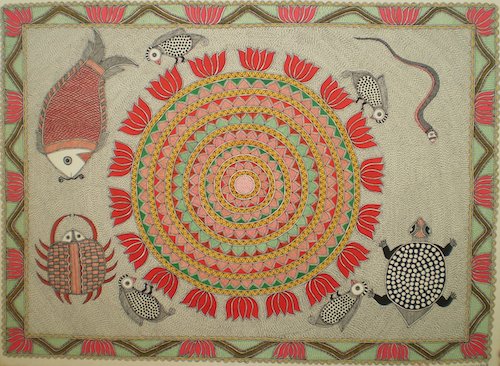
Below another early piece.  The traditional lotus pond.  But again, the work is far from a copy of the standard theme.

The Lotus Pond, 22″x30″, 2005.

OLYMPUS DIGITAL CAMERA

The central lotus, a pinwheel of many concentric circles of similar hue, is dominant and almost hypnotic in its effect while the surrounding pond with its clearly delineated animal figures provides a visual respite from the spinning center.  Look at Amrita’s work on the wonderfully decorated aquatic animals.  They are stylized but their carefully chosen decoration adds an individuality and makes us look closely at each.  Careful hatching of the ground adds texture to the work.  Click here to appreciate the detailed work.

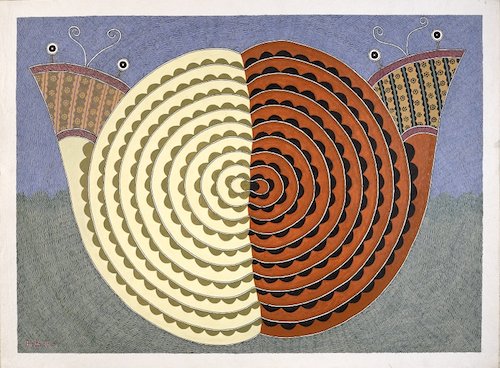
Two Snails, Ardhanarishwara  22″x30″, 2008.  Private collection.      

he work is similar in design to The Lotus Pond of three years earlier, but now there is  hardly a hint as to its Mithila origins.  The cool color palette, the repetitive but simple circular decoration of the snail shell, the hatching of the ground so minute that it gives a soft delicacy to the entire painting, all this contributes to a peaceful, contemplative mood without diminishing the power of the piece.  

Although the style is not traditional,  Ardhanarishwara is a common subject in Mithila art.  It refers to the Indian philosophical concept that male power is dormant without the female energy necessary to set it in motion. In art this is usually expressed by the androgynous figure of the god Shiva and his consort Parvati.  Amrita chooses to represent this idea by two snails, male and female, inhabiting the same shell.   An example from the world of simple creatures to express a universal truth.        

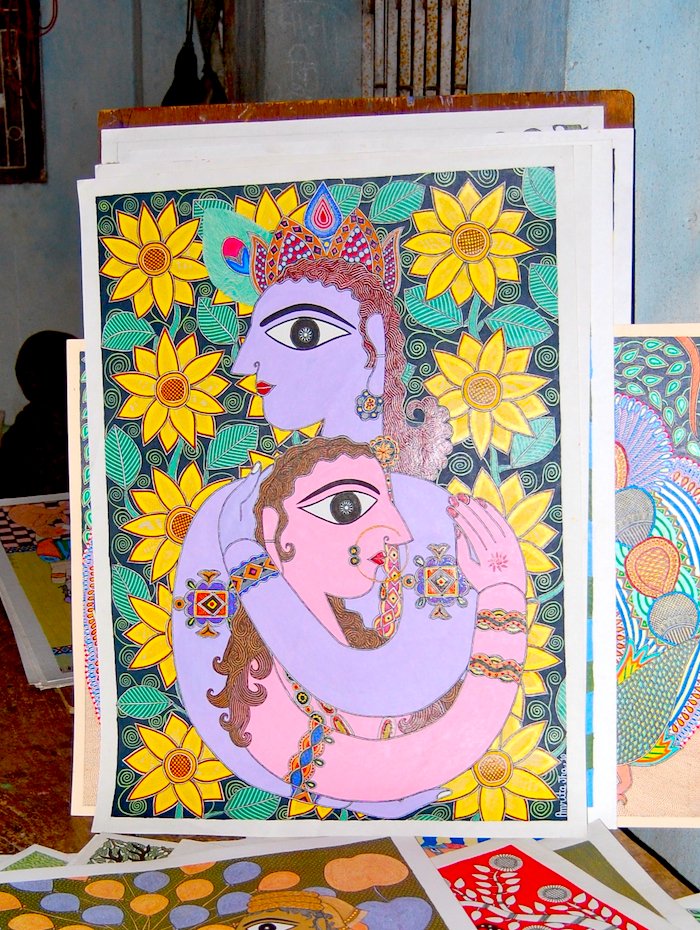
The Lovers 22″x30″, 2009.

We have left the usual Radha Krishna representation behind.  As in her traditional treatment of this theme above, Kadamba flowers frame the work but now there is no place for the subtle gesture of affection or belonging.  This painting is direct in its sensuality.  Radha rests her head against Krishna’s bare chest as their elongated bodies, decorated only with jeweled bracelets, enfold one another.  The profile faces and almond shaped eyes indicate a Mithila tradition.  The lovers’ quiet passion and contemporary treatment however are the artist finding her own way within that  tradition. 

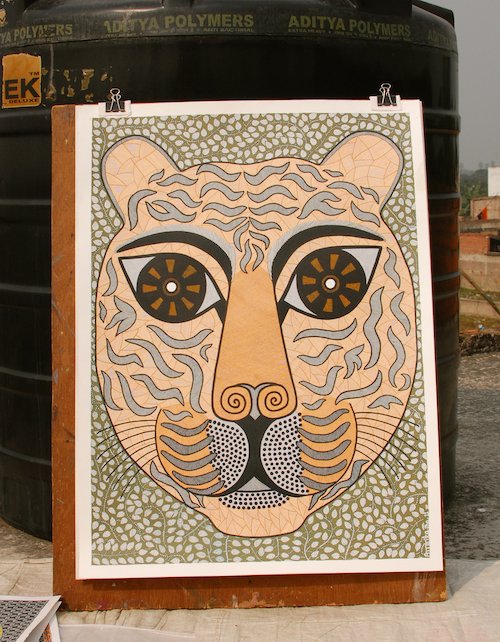
The Tiger, 22″x30″, 2011.  Photographed on the roof of Amrita’s house in Madhubani,  January, 2012.

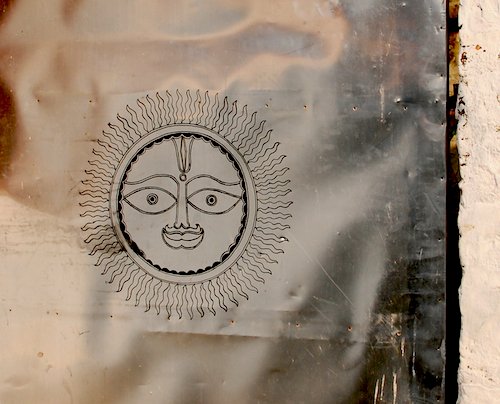
Amrita is now working in the highly decorative style first executed in Two Snails.  The figure fills the canvas and the painting is minutely worked:  the brown irises flaked with bits of almost invisible color, the tiger’s face marked with soft lines creating geometric shapes of varied hues, stylized patterns decorate its forehead and cheeks while the wonderfully drawn nose and mouth are balanced by the large hypnotic eyes. Though not at all in the usual Mithila style, the piece is reminiscent of the small traditional images of Surya, the sun god, that often decorate the entrances of homes in the Madhubani area.

Surya on entrance gate, Madhubani district, Jan 2012.  

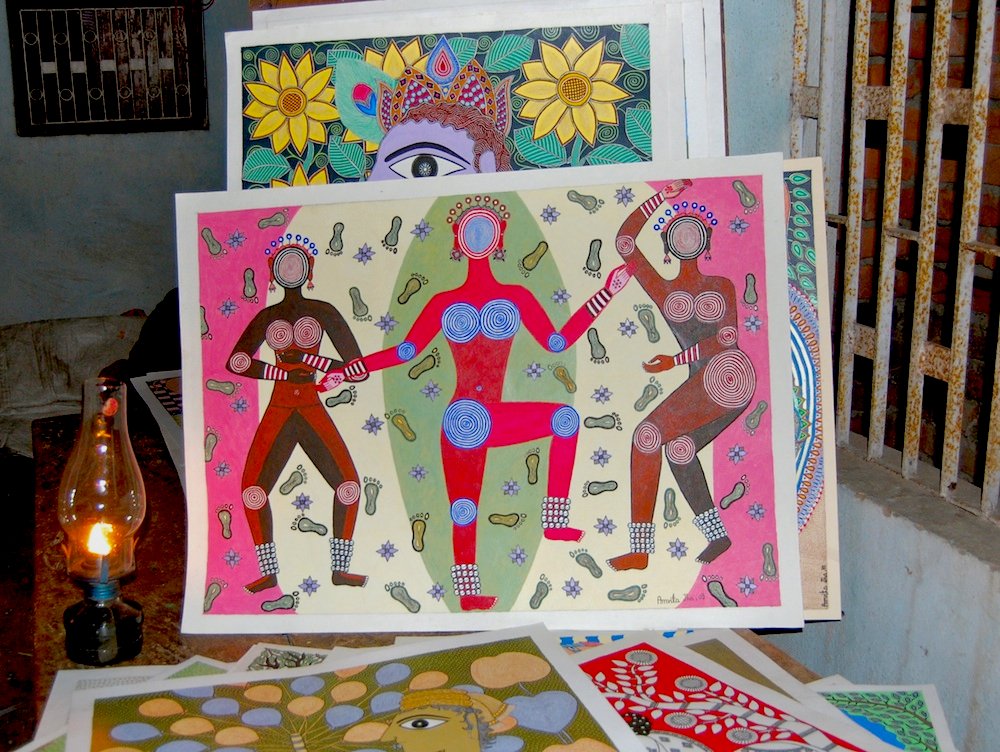
 would like to conclude this post on Amrita Jha with a painting I saw at her home in Madhubani a couple of years ago.  It was a damp January evening in 2010 and getting dark.  The city had not yet turned on the electricity so Amrita brought out a kerosene lamp. 

The Dancers, 22″x30″, 2009.

I was taken aback by the work.  Nothing I had seen in Madhubani prepared me for this painting.  The footprints are dance steps but they also refer to the Devotthan aripan. That is a traditional floor design made with rice paste that depicts the footsteps of the goddess going from the courtyard to the special room set aside for her worship in the house.  

Nested ovals frame the outlines of the three female dancers.  The central figure in red with tightly painted bluish concentric circles for face and breasts, elbows and knees captures our attention.  She faces us directly, confidently, arms open, hennaed palms forward.  Her two sister dancers also look out at the audience.  All three almost confronting the viewer as they perform the steps of this goddess dance.

In Two Snails Amrita Jha quietly asserted the importance of the feminine in the world of male power.  Here the emphasis is on the independence of the feminine.   These female dancers are not seeking anyone’s approval.  They are dancing their own dance, exulting in their own power.  It is the artist herself dancing the steps of her artistic journey, an affirmation of her art and of her feminine being.  It was with this painting, Amrita said, that she began to seek her own visual vocabulary in earnest.  

Rural Murals

Decorating a compound in a rural area outside of Madhubani.  

This post is the last of three on mural painting.  We began in the town of Madhubai with the city murals of Dulari Devi and Abha Das and here we’ll take a look at some rural murals.

We left Madhubani and were driving quickly, late for a meeting with a village artist, when we passed the scene in the photograph above.  Late or not, we had to stop.  

Local women artists were decorating a former art cooperative in Jitwarpur village in honor of the Chief Minister of Bihar who was visiting the area for a few days. These rural murals painted on the walls of homes and buildings are simpler in design than the highly complex line work of Dulari Devi and Abha Das but no less attractive.   The figures are well drawn, broadly outlined with little detail, and the empty areas filled in with bold, bright colors. 

Below is another mural in the compound. The clean outline and large areas of color quickly define the subject and render it intelligible at a glance even from afar. 

This horse and rider is a very lovely piece with its tall, blue rider upright in the saddle, his right hand raised in an authoritative gesture.  The fine red cloak and headdress serve as a backdrop to his blue form and indicate he is someone of importance.  His regal horse, richly caparisoned, decoratively painted and well groomed with braided tail and combed forelock also signals this is no ordinary rider.  I wondered who this might be but we were in such a hurry that I had no time to ask.  Normally, blue is Krishna’s color but this did not appear to be the god.  There are no symbols here to tie this image to Krishna.

But, when further on I saw this unfinished painting, I guessed the blue rider was Moti Ram, the companion of the Dusadh (a laborer caste) hero Salhesh.

This is a beautiful, well designed and evenly balanced drawing of Salhesh mounted on an elephant with his elephant driver.  Note the bird resting on his left hand.  At first, the work appeared to depict a hunting party, Salhesh with  a hawk on his wrist, an appropriation of royalty by the low caste champion.   But looking closer it was clear that the bird was not a hawk but a parrot and so the reference was to Salhesh’s empathy with nature, the forest and its flowers, birds and animals.  The painting however is reminiscent of a royal hunting party and perhaps this was the artist’s intention since it provides an aristocratic association for Salhesh.  Click here to enlarge.

Along the bottom of the wall is a charming procession of the Salhesh party.

Salhesh in the lead on his elephant is followed by the rest on horseback. They are approaching what might be Salhesh’s Garden, a magical place in the forest, with the Tree of Life and parrots in its branches.    

Finally, here is a work in progress.  

This is Krishna and a gopi (milkmaid), he with his flute and she with her milkpot. There is a little more detail here than in the previous paintings but the decoration is still minimal. The piece seems a bit bland but once the areas are painted in with color  the work will become as attractive and pleasing as all the others.  

Lalita Devi and Her parrot

Lalita Devi’s Parrot: 
The Beginnings of the Art

The painter Lalita Devi in Simri village, Madhubani area,  Jan 2012.

Rambharos took me to see Lalita Devi, an older painter who had flourished in the 80’s and whom he much admired. He remembered her as a very experimental, innovative and lively artist.  Today however she was quiet and subdued.  I wanted to meet her to ask about a feminist painting she did many years ago showing the many armed goddess Durga with a broom and pots and pans in her hands rather than weapons.    “A man told me this was not Durga”, she said.  “I told him that he keeps looking for Durga in the sky but does not see the hundreds of Durgas around him”.

As we continued to talk about her earlier work she became energized and brought out a few of her recent paintings.

Below is ‘Krishna breaking the gopi’s milk pots’, painted in soft tones using natural colors.  Although Krishna teasing the milkmaids is a standard theme in Mithila painting, Lalita Devi gives it a feminist turn by making the milkmaid a much more active player than usual in the scene.  Her hold on Krishna’s ankles is as much a restraining movement as a pleading one. 

When we were getting ready to leave I asked if I could take a portrait of her next to a wall drawing of a parrot.

Lalita immediately said that would not do.  She asked me to wait a moment, returning in a few minutes with several green leaves in her hand.  She had drawn the parrot a few months earlier with leaves like these and would refresh it now.  The leaves are from the Sim plant which artists used for the color green before they had store bought paints.  Crushing the leaves between thumb and forefinger she began carefully but quickly to paint over the lines of the faded parrot. 

She adds the finishing touch to her parrot drawn with the crushed Sim leaves.  

Lalita Devi may not paint very much any more, but this act of painting was a wonderous thing to see.  Rambharos and I both watched with a sense of history and a sense of participating in a timeless ritual.  Mural painting is the origin of the Mithila painting we now have on paper.  And here we had just witnessed the beginning of mural painting. 

I had wanted a portrait of Lalita Devi.  What better portrait could I have of her than this!

Peter Zirnis   Jersey City, March 2012. 

Murals: The Origins of Mithila painting

The city of Madhubani commissioned a series of murals based on the Ramayana for its memorial building honoring the 14th century national Maithili poet, Vidyapati.  Here Dulari Devi (right), whose work I’ve written about previously,  and Abha Das (left) stand in front of one of their panels.   Madhubani,  Jan. 2012.

Although Mithila artists now paint primarily on paper, they sometimes do get an opportunity to return to the origins of their art and work on a mural.  On last month’s visit to Madhubani I was lucky enough to see three such examples.  One was in Madhubani itself where Dulari Devi and Abha Das were working on a sophisticated series of panels on the Ramayana story.  The second was at a rural women’s cooperative where the artists were busy decorating buildings with beautiful, colorful murals quite different in style from those of the  city.  And the third, in Simri village, where I watched with wonder and a sense of history as Lalita Devi carefully sketched a parrot on her courtyard wall using only a few crushed green leaves for a paint brush.  In this post we’ll look at the Ramayan murals in Madhubani.  The next post will cover the ‘rural’ murals and Lalita Devi’s wonderful painting demonstration. 

The City Mural:  Here is a detail from the above Ramayana mural.  Although ‘detail’ is relative here since I estimate this to be about 4 or 5 feet high.

This is a masterpiece of color and design with its myriad decorative detail creating an exciting visual energy in the work.  Rama and his brother Lakshmana, one behind the other, are almost identical in stance, dress and ornament.  It is the color of their dress and the details of their ornamentation that sets them apart.  Dressed in royal finery with caps and well wrought earrings, throat and upper body covered with jeweled necklaces and garlands fashioned from precious stones, decorative bands at wrist and elbows, they are imposing figures.  Beautiful long robes cover their shoulders and flow down to the ground while their diagonally striped dhotis and contrasting sashes complete their regal appearance.  Even their weapons are finely fashioned  with intricately decorated quivers, colorful arrow heads, and bows inlaid with polished gemstones.  These are truly the god-like figures they are meant to be.      

Dulari Devi has come a long way from the menial labor days she describes in her painted autobiography  Following My Paint Brush.  She is now an accomplished painter, and in mural painting perhaps without equal in the Mithila area.

Murals in Progress:  I was happy to see that some of the Ramayan panels were still being completed while I was in Madhubani for this allowed me to see mural painting in progress.  Below are a number of unfinished panels. This scene appears to be the breaking of Shiva’s bow by Rama, with Ravanna, the ten headed demon king, symbolically looking

Look especially at the flowers in the center of the piece.  Note the soft shadows of the underdrawings that appear to have been painted over when the artists changed their design.

The mural is elaborate in detail and patterning with almost no space without some decorative element. Rama and Lakshmana are again similarly represented in their royal dress, although here Rama is significantly the larger figure as befits his important status.  Notice that when the detail is as filigreed as it is in these sophisticated, what I am calling ‘city’ murals, how important color is in helping the eye make sense of the myriad details and lines.  Glance at the group of spectators at the top of the mural. Except for their eyes they all blend into a confused if interesting crossing and hatching of lines.  Or look at Lakshmana.  Where color has been added, we easily differentiate and enjoy the various items of dress while the rest disappears in a multitude of small lines and white spaces.

Next is a section of a mural in its very early stages

We can see the mural in progress as we look from left to right.  The preliminary outlines are painted in a light color and then later painted over with a stronger black line like that on some of the figures on the right.  That is also when the details are added and any black areas filled in.  

Below Dulari Devi works on the outside wall of the small Vidyapati memorial building. 

One can clearly see her materials of rags and newspaper, her store bought acrylic paints and half a dozen brushes of different size.  The Mithila artist Rambharos told me that Dulari does not test her colors on a pallette but prefers to use her hand.  A quick dab on the palm to see whether the color is right.  

Shiva’s Bow in the Ramayana:  Through the bars of the window above the mural Dulari is painting, one can see the top of another mural inside the building.  

his is the famous incident in the Ramayan story where Sita, future wife of Rama and the adopted daughter of King Janaka,  picks up the bow of the god Shiva. It was so heavy that no man could lift it.  To Janaka’s amazement Sita, while cleaning one day, easily lifted the bow out of her way.  It was one more sign to the king that his adopted daughter was no ordinary mortal.  

Please feel free to comment.

Her Story: Sita

You open the book.  After a couple of delightful pages with small oval portraits of the cast of characters set against the black paper, the next page is blank. Both pages facing you are solid black.  A field of black, dark charcoal.  As your eyes move over the two empty pages you notice, in the lower right hand corner, a small white rectangle as if cut out from a typed sheet and pasted onto the black page.  The text reads: “For a thousand years the Dandaka forest slept.”  A shiver of anticipation.  This is going to be great, you think.  You turn the page, the story begins, and you are not disappointed.

This is Sita’s Ramayana,  a retelling of the Ramayan, India’s great national epic, in graphic novel form.  Based on a 16th century Ramayan by a Bengali female storyteller, Sita tells her version of the Rama and Sita story, their exile, her abduction by the demon Ravanna, Rama’s long battle to get her back, and then, after victory, his rejection of her. 

Published by Tara Books, this graphic novel is a highly successful blending of image, text and design.  Bengali artist/storyteller Moyna Chitrakar’s paintings, Samhita Arni’s text and Jonathan Yamamaki’s design come together to create a dramatic, exciting, and poignant story that invigorates an epic most people familiar with the tradition think they already know.  

Below is Sita in captivity, longing for Rama. 

Visually the image is arresting.  Sita, like a sorrowful angel in some early Italian painting, her sari billowing against a starry sky of white buds on somber trees, anxiously waits for Rama to rescue her.  The black expanse of the page adds to the dark mood.  Against that black page, the white rectangles lead you down step-like to that final sentence :

“He would come, I told myself, every day.”

“He had to come.”                                                                                                     

 “I couldn’t bear to think otherwise.”

You feel the intensity of her emotion and understand her near despair.  Arni’s precise use of everyday language along with Yamamaki’s graphic design give Chitrakar’s traditional painting a modern sense that makes this a compelling scene for the contemporary reader.

Here is Sita waiting for Rama after the defeat of the demon Ravanna.  

Note again how effectively image, text and design work together to move the story along and show us Sita’s emotional state of mind.  The two small panels prepare the reader for the long-awaited reunion with Rama while Arni’s few sentences signal that all is not well.  Ravanna is defeated, but where is Rama.  Why has he not come?  He is busy crowning a new king. But then, Rama still does not come.  Instead, his trusted messenger appears to summon her.  Something is not right.  At the top of the next panel, the chilling words: “It wasn’t anything like I imagined.” prepare the reader that the reunion will not turn out as expected.  Short, succinct, intense, dramatic.  You want to keep on reading.

As I assume you can tell by now, I thoroughly enjoyed Sita’s Ramayana.  And although the work is obviously not in the Mithila art tradition, I found this graphic novel so fresh and exciting, and some of the images so memorable, that I wanted to bring it to your attention.  The book is available in the US from Amazon, among others, and was, by the way, recently on the NY Times best seller list. 

Her Story: Dulari Devi

“I am an artist, but I wasn’t always one.”  This is how Mithila artist Dulari Devi begins the account of a life that moves from extreme poverty and constant menial labor to that of an accomplished and recognized painter.   Following My Paint Brush is her story told in thirty two pages of colorful, autobiographical drawings accompanied by a few sentences that give voice to her images.  Published by Tara Books with their usual high quality, the book is in hardcover with luminous white pages and crisp colors that show Dulari’s work to good effect. 

In the first painting we see Dulari as a little girl accompanying her mother to work in the rice fields.  Note the clean lines of her figures and the nearly semi-circular billow of the saris.  Although a standard way or representing the sari in Mithila art, Dulari seems to make it a trademark. Perhaps because she often leaves the backgound empty, as in these drawings, the curve of the sari is more prominent than it otherwise would be.  

As she recounts in the book, her unhappiness with her life began to change when she started to visualize scenes that she passed everyday as paintings.  These images stayed with her during the day and relieved some of the daily drudgery.  Then came a stroke of enormous good fortune.  She began working as a maid in the home of a successful Mithila artist, Mahasundari Devi.  Facinated by the paintings, she asked if she also could learn how to paint. That was the beginning of her new life.

The Ice Cream Man is one of those ordinary scenes that Dulari used to imagine as a painting. This is a happy piece as befits its subject but note the careful, formal structure that supports the simple scene of children buying ice cream.  While the tree in the center divides the drawing in two and separates the children on one side from the ice cream man on the other, a canopy of branches with green and yellow leaves interspersed with red berries spreads over and encompasses the entire scene.  On each side of the painting a leafy branch reaches down just enough to give a gentle caress to the outside figures and bring them all into the fold.

In addition to her everyday, rural scenes, Dulari is also well known as a painter of Ganesh images.  Here is a Ganesh painting from 2010 now in a private collection. 

   The Ganesh is quite a change from Dulari’s quiet paintings of everyday village life with their realistic but prosaic colors.  Here the intense, intricate patterns and color, on every inch of canvas, overloads our senses.  At first only the  eyes are clearly visible while all else is an almost psychadelic profusion of color and pattern.  As we begin to separate shape from pattern, Ganesh’s full form fills the entire canvas while decorative foliage occupies any remaining space.  This is not a painting of what Dulari sees daily in her village of Ranti. No longer bound to record what is actually there, she gives free reign to her imagination and with exuberance depicts this most favorite of gods.

Here is a photo from 2010 in the home of Mahasundari Devi where Dulari Devi learned to paint.

From the left: Bibha Das, Mahasundari Devi, Dulari Devi, Vibha Jha. 

Both Bibha Das and Mahasundari Devi have received national recognition as artists. Dulari Devi is sure to receive that honor soon. Vibha Jah is with the Ethnic Arts Foundation. 

Below is one of many decorative murals painted by Dulari in her employer’s home. Note the same clean forms – and those ballooning semicircular saris. 

I first met Dulari Devi in January of 2010.  She had recently finished the illustrations for Following My Paint Brush and was still working as a maid.  Her art was gaining recognition and her hope was that soon she would be able to paint full time.  I saw her again a year later.  She said she was no longer working as a maid.  She had become a full time artist. 

Following My Paint Brush is available in the US.  Amazon carries it at $13.65.  A great stocking stuffer for yourself or as a gift.

The art of Rambharos and Tara book

I’ve wanted to do a post on the Mithila artist Rambharos for some time and Tara Books in Chennai, India has now given me the perfect opportunity with their publication of Waterlife, a beautiful volume of his paintings of the aquatic life that inhabits the ponds and lakes of his boyhood home. 

Waterlife is a handmade book of high quality with 12 hand silkscreened prints on handmade paper in a limited edition of 3000 .  From the solid feel of the cerulean blue cover with its image of a large whale-like fish to the texture of the handmade paper within – with its styllized but alive paintings of crabs, turtles, and imagined creatures – there is nothing about this volume that does not delight.  The printing is superb with even the smallest details clearly delineated while the colors stay vibrant and sharp.  A short  paragraph that introduces each painting to give some background on why Rambharos choose that particular image also adds greatly to the enjoyment of the pieces.

Here is Marriage Symbol.  His rendering of the traditional lotus painting at marriage ceremonies.      

It’s a joyous piece with a contemporary feel.  The white swans gliding, almost flying, on the dark blue water while the lotuses with their long stems curve over each other forming a trelissed archway to the new beginning for the married couple.  The apparent simplicity of the piece is misleading.   Notice how a curved line is used to create volume in the lotus flower, a short angled line for the supple stems, and note especially the dashes to render movement in the water.  The dash lines are not at all random as they first appear.  Look at the two large lotus flowers.  Rambharos draws them slightly differently as they respond to the water’s flow.  The one on the right has all its petals lying in the same direction as the water. The dashes, the water, flow uniformly around it.  The lotus on the left, the petals are more open as they respond to the water’s turbulence. The dashes are closer together, here and there, angled.  The water is not all in the same direction and causes the petals to separate.

Here is The Octopus at Home, an imagined octopus at mealtime.

A whimsical, almost playful piece but a closer look again reveals the careful choices Rambhros made to achieve this apparent childlike simplicity.  The figures stand out clearly from their aquatic background and, as in the Marriage piece above, each figure has its unique pattern of lines and cross hatchings.  Here however the background, the water, takes on a very complicated look with swirls, curlicues, dashes, dark and light. The different patterns divide the picture plane into quadrants around the central figure of the octopus, each pattern a setting for the starfish and the other three sea creatures.  Rambharos continues the tradition of Mithila artists who used to fill the empty areas of their paintings with foliage or other decorative elements, but he almost turns the tradition on its head by making that empty space a principle element in the painting.  

Rambharos began as a traditional Mithla painter and with hindsight we can see hints of his later style in the early paintings.  Look at this piece from 1996 entitled Fish and Butterflies.

The work is clearly recognizable as Mithila with its border and traditional motif of lotus and pond and fish. But already we see water holding an important place in the work. Not only does it take up three quarters of the painting but the attention given to its representation is an indication of what is to come later.  Note also that this early piece has the same formal arrangement as the Octopus painting above. The lotus plant divides the painting vertically into two mirror images while the water line separates the sky and water giving us a similar quadrant setting.  Instead of the octopus however, we have a stylized lotus flower at the center. 

Twelve years later in 2008  there is Snake Goddess.

OLYMPUS DIGITAL CAMERA

The painting, a stunning piece that is part of the EAF’s Travel Exhibition,  has many of the elements of Mithila art, the signature almond eye and the pond creatures, but in design and execution Rambharos has made the tradition his own.  He is now moving toward a minimalism in representation, looking for the simplest means to render the traditional motifs of Mithila art but yet imbue them with a vitality that is more than real.  The turtle, the lotus, the snake, all iconic representations, simply drawn yet very much alive.  And note the water, the lines drawn individually with a nib pen, the current, the movement, coming together, apart, in all directions.  A pond has never looked more alive.

Rambharos has moved well beyond the tradition.  As he painted, as he worked at this art, he began to expand his vision and with that his visual vocabulary.  As he puts it, he began to follow the line of his hand.  Waterlife is a both a result and a part of that process.  The style is not Mithila but the foundation and spirit is.

Waterlife will be available in the US in April, 2012.  For those who can’t wait (like yours truly) or perhaps need an exceptional holiday gift, they can order it directly from Tara Books and have it delivered in three days.  The shipping costs as much as the book but if you order an extra gift copy or two (or get together with some friends) this reduces the cost significantly.    

Salhesh, The Book, The Movie

I didn’t want the previous post to leave you with the impression that all the paintings related to the Salhesh story are in black and white.  Look at this delightful painting of Moti Ram, Salhesh’s brother, by Shanti Devi, the very accomplished Dalit painter.  It doesn’t have the look of a Mithila painting.  One might think it is a flat weave rug or an embroidered wall hanging from Rajahstan.   But it is Mithila, as David Szanton in a soon to be published article points out.  This was a style taken up by a number of Dalit painters in the late 70’s, including Shanti Devi.  It is distinguished by a double line with black dots outlining figures and outlining the border itself.  The central image is Moti Ram.  He is facing us flanked by two rearing tigers in profile, almost as if this were a heraldic piece.  The open area around the three figures is filled with flowers and birds, standard Salhesh motifs, all outlined with the same double line technique.  

Here is a second painting by Shanti Devi on the same theme of Moti Ram hunting.

Again this has the look of a heavily embroidered fabric although Moti Ram’s almond eye tells us we are in the Mithila world.  At first glance you just see a maze of color.  The entire painting is filled with images, lines, dots.  Color everywhere and it takes some work to distinguish individual shapes.  But once your eye has made sense of this colorful confusion you immediately take pleasure in the imaginatively rendered individual figures.  Particularly look at how Moti Ram is seated on his horse.  You see the soles of his feet.  Their position indicates he is sitting cross legged on some sort of saddle platform mounted on the horse.  And look how that circular form of ( I’m guessing)  black saddle and red cloth is repeated in the orange oval body of his horse with its three small black and yellow shapes there set in a semicircle.  Circles, and circles within circles – the whole in a delightful swirling motion.  Also note how the eyes of the three main figures catch our attention, the large round black dot in the white of the eye, and create this triangle of Moti Ram, the flower girl and Moti Ram’s horse.  They, and the smaller ‘flower’ figure below the horse’s head, the only sentient beings in this dense, overgrown jungle of color.          

 This painting, by the way, is included in the Ethnic Arts Foundation traveling exhibition and, at least for me, is one of the most enjoyable paintings among many in that show.

The Book and the Movie.  I want to draw your attention to these because they place the Salhesh paintings in a social context and add a personal, human dimension to the aesthetic appreciation of the work on and about Salhesh.

Let’s do the movie first.  Aarakshan was released in India a couple of weeks ago to quite some controversy with two states even banning its showing.  The word means ‘reservation’ and refers to the quota system that sets aside a percentage of seats in schools and universities for Dalit and other disadvantaged groups.  The movie does not concern itself with Salhesh, of course, but the controversy it has caused adds a contemporary dimension to these paintings of a legendary hero.  The Times of India took this opportunity to write an article about the harassment, bullying and intimidation of Dalit students at elite schools, harassment so severe that it has driven a number of them to commit suicide. ( It is a very informative article but the linked pages are so full of ads that one has to look carefully to find the link to the 2nd and 3d page.)

The book.  This contempt for the Dalit classes, however, takes a strange turn in modern Indian politics. Badri Narayan in his Facinating Hindutva tells a truly facinating story about how the Hindu nationalist party in India is actively working to rewrite the story of Salhesh, and other Dalit heroes, in order to bring the Dalits into its political fold and garner their votes.  The same Dalit, who is shunned and treated with contempt by upper class Hindus and disparaged in some of their classical texts, is now told that Salhesh, their cultural hero against this religiously sanctioned discrimination, is actually a Hindu, a protector of Hinduism and in fact a Hindu god, the incarnation of Lord Ram!  Whether this rewrite of memory and history will take hold is still to be seen but Narayan’s book is well worth reading to see the dynamic between the tradition and the new social and political reality.  

Salhesh, Dusadh Hero

I thought I would move away from the broader Mithila tradition in this post and take a look at paintings by one particular group, the Dusadhs, and particularly at their representations of Salhesh.

In the state of Bihar of which Mithila forms the northern part, the Dalit (untouchable) castes have their own heroes and stories outside of the classical Brahmin tradition. Among the Dusadh caste, the watchman caste, which numbered over four million in the Bihar 2001 census, Lord Salhesh is revered as a hero and demigod.  

The earliest printed Salhesh story seems to be that of the British colonial official and scholar George Grierson.   In his collection of popular stories and poems in the Maithili language published in 1882 there is that of  ’King Salhes’.  Grierson says the story is known throughout the region and that in the villages one can see Salhesh shrines under pipaltrees with clay figures representing the characters in the story.

The story, as told to Grierson, is both a love story and an adventure tale. Salhesh is the appointed watchman of a king’s realm and his reputation is so fierce that no one dares commit any thefts.  When the queen’s golden bed is stolen in the middle of the night by a bold thief, Salhesh is blamed and in danger of losing his life.  His lover Dauna Malin uses her magic and her beauty to rescue Salhesh and help him return the golden bed to the king. 

Today there are other stories told about Salhesh.  He is remembered as one who possessed magical powers in his own right and he is remembered as a Dalit who had to endure insults and discrimination on his way to becoming a powerful king.  There are festivals in his honor and the Dusadh as well as other Dalit castes come to workship and pray at his shrines.

Here are two small paintings I purchased in Delhi in 2010.  They are a matched pair of Salhesh and his brother Moti Ram.  Below is the Moti Ram piece.

Moti Ram sits confidently astride his horse.   Both horse and rider are at a slight angle leaning back which gives the impression that the horse is rearing or about to charge forward. The image of a warrior going into battle.  The medallion is heavily ornamented with Moti Ram tightly  framed by flowers and bushes.  In the full painting two pairs of love birds decorate the top of the painting with two Malin girls at the bottom.  Frequently in drawings of Salhesh and Moti Ram, as in both of these pieces, the faces are simply two straight lines forming an angle with a dot for the eye – just a notation to indicate the head in profile – there is no signature Mithila almond shaped eye.

The Salhesh painting is similar in style to that of Moti Ram but the scene in the medallion is quite different.  

This is not the image of a warrior about to charge but rather that of a commander firmly mounted on an elephant at the head of his army.  The pace is slow, steady and purposeful as befits the leader of a people.   Dauna Malin walks behind  Salhes.  In the background, a third figure seems to be carrying a weapon.  I would suggest this might be Kari Kant who is specifically mentioned in Grierson account as coming along with Moti Ram to help Salhesh.  The full painting has the same dense jungle foliage look as that of the Moti Ram piece but peacock tails frame the painting instead of tree trunks and the central medallion is dramatically outlined with a wide black circle within which there are small white dots where the area has deliberately not been painted black.     

Here are three more black and white paintings for this post on Salhesh. These are tattoopaintings by Dalit artists, so called because when the Dalits first began to paint they used the repetitive decorative tattoos on their bodies for inspiration.

The first is a simple but quite beautiful piece from 1988.  It takes the style of a Krishna rasa lila piece but no flute and the elephants tell us we are dealing with Salhesh and not Krishna, so the dancing figures in the circle are Salhesh’s Malin maidens and not Krishna’s milkmaid Gopis.  Note again the simple notation for the head in profile.  Also the birds and butterflies, a common motif in Salhesh paintings. 

Next is a close up of Urmila Devi’s painting, Salhesh and Moti Ram. She also uses the circular form but instead of Krishna and Radha dancing in the center we have Salhesh and Moti Ram around a tree of life.  Elephants and horses, their respective mounts, fan out in alternate circles to occupy the rest of the painting. This is a very well drawn piece. Note the elephants marching solemnly along while the horses have quite a lively look with flying manes and hoofs.

The last painting is a striking tattoo piece, Ghosts of Salhesh, by the late Chano Devi who died in the spring of 2010.  The repetition of the single black figure and the wavy uneven line adds to the other worldly effect.