When I first saw Mithila paintings on the streets of New Delhi a few years ago, I found among the many quickly drawn pieces for the souvenir trade a few that stood out. They were particularly strong, energtic, with a good sense of design and color. Later when I traveled to the Madhubani area, I was greatly surprised by the quality and variety of the work, both in town and in the surrounding villages. I was not prepared for the many paintings that dealt with contemporary social and political issues and for paintings that did not look like Mithila paintings at all as artists sought new ways to express themselves.
The painter Amrita Jha is part of that small group of young, serious artists in Madhubani that is trying to reconcile the traditional with the contemporary. It is already clear from her early work that she was not an artist content to simply follow but was already engaged with the tradition.
Radha Krishna, 22″x30″, 2005. Private collection.

The lines are bold and sure, the colors harmonious. The flowers of the Kadamba tree burst like celebratory fireworks over the loving couple. Krishna in the traditional cross legged stance with flute in hand, Radha behind him. But look at her hand on his shoulder. An assertive gesture, a supportive gesture, not one usually seen in depictions of Radha Krishna. Radha is claiming Krishna for herself as Amrita Jha is claiming this painting tradition for herself.
Below another early piece. The traditional lotus pond. But again, the work is far from a copy of the standard theme.
The Lotus Pond, 22″x30″, 2005.
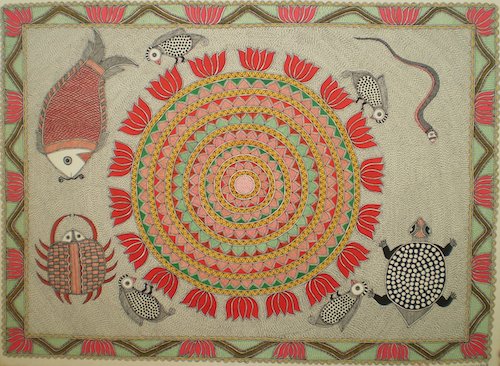
The central lotus, a pinwheel of many concentric circles of similar hue, is dominant and almost hypnotic in its effect while the surrounding pond with its clearly delineated animal figures provides a visual respite from the spinning center. Look at Amrita’s work on the wonderfully decorated aquatic animals. They are stylized but their carefully chosen decoration adds an individuality and makes us look closely at each. Careful hatching of the ground adds texture to the work. Click here to appreciate the detailed work.
Two Snails, Ardhanarishwara 22″x30″, 2008. Private collection.
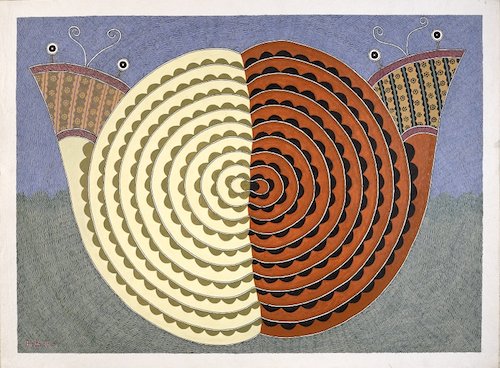
he work is similar in design to The Lotus Pond of three years earlier, but now there is hardly a hint as to its Mithila origins. The cool color palette, the repetitive but simple circular decoration of the snail shell, the hatching of the ground so minute that it gives a soft delicacy to the entire painting, all this contributes to a peaceful, contemplative mood without diminishing the power of the piece.
Although the style is not traditional, Ardhanarishwara is a common subject in Mithila art. It refers to the Indian philosophical concept that male power is dormant without the female energy necessary to set it in motion. In art this is usually expressed by the androgynous figure of the god Shiva and his consort Parvati. Amrita chooses to represent this idea by two snails, male and female, inhabiting the same shell. An example from the world of simple creatures to express a universal truth.
The Lovers 22″x30″, 2009.
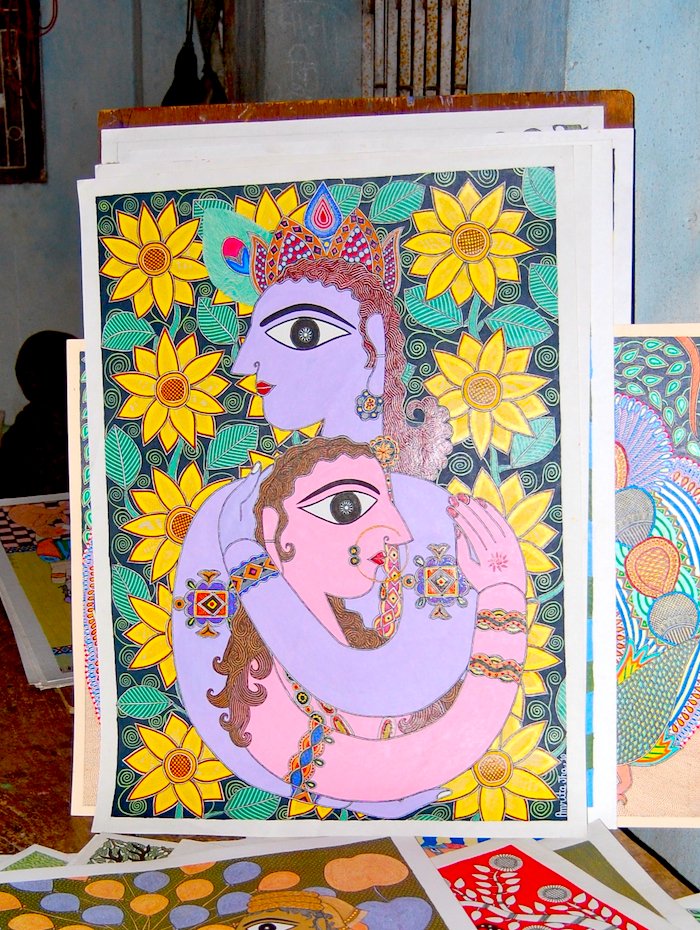
We have left the usual Radha Krishna representation behind. As in her traditional treatment of this theme above, Kadamba flowers frame the work but now there is no place for the subtle gesture of affection or belonging. This painting is direct in its sensuality. Radha rests her head against Krishna’s bare chest as their elongated bodies, decorated only with jeweled bracelets, enfold one another. The profile faces and almond shaped eyes indicate a Mithila tradition. The lovers’ quiet passion and contemporary treatment however are the artist finding her own way within that tradition.
The Tiger, 22″x30″, 2011. Photographed on the roof of Amrita’s house in Madhubani, January, 2012.
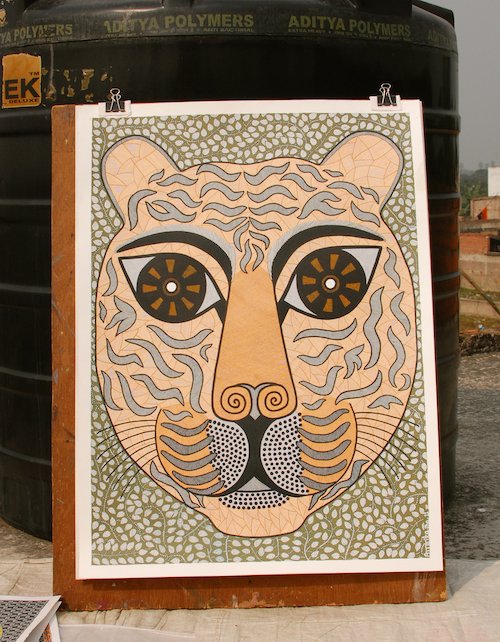
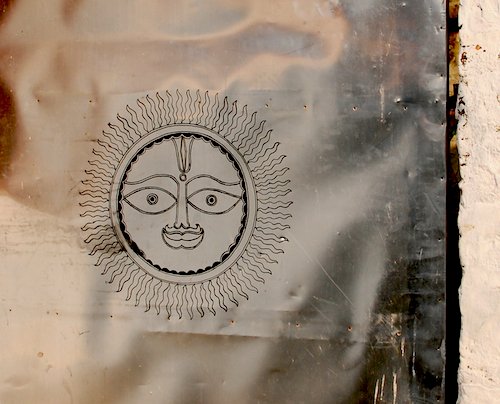
Amrita is now working in the highly decorative style first executed in Two Snails. The figure fills the canvas and the painting is minutely worked: the brown irises flaked with bits of almost invisible color, the tiger’s face marked with soft lines creating geometric shapes of varied hues, stylized patterns decorate its forehead and cheeks while the wonderfully drawn nose and mouth are balanced by the large hypnotic eyes. Though not at all in the usual Mithila style, the piece is reminiscent of the small traditional images of Surya, the sun god, that often decorate the entrances of homes in the Madhubani area.
Surya on entrance gate, Madhubani district, Jan 2012.
would like to conclude this post on Amrita Jha with a painting I saw at her home in Madhubani a couple of years ago. It was a damp January evening in 2010 and getting dark. The city had not yet turned on the electricity so Amrita brought out a kerosene lamp.
The Dancers, 22″x30″, 2009.
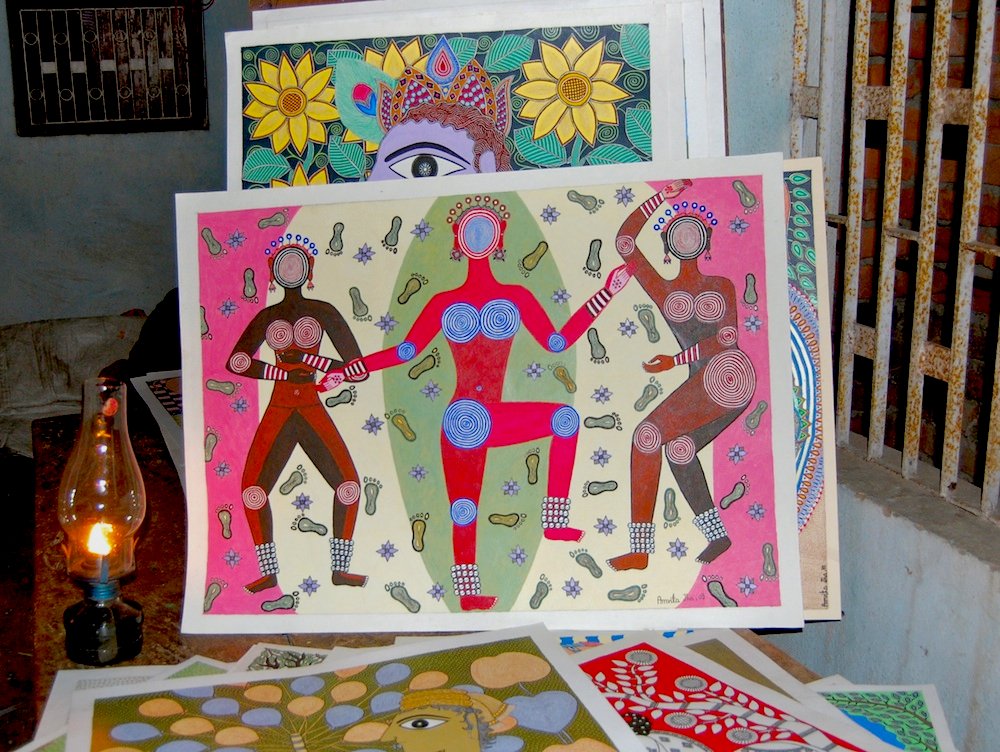
I was taken aback by the work. Nothing I had seen in Madhubani prepared me for this painting. The footprints are dance steps but they also refer to the Devotthan aripan. That is a traditional floor design made with rice paste that depicts the footsteps of the goddess going from the courtyard to the special room set aside for her worship in the house.
Nested ovals frame the outlines of the three female dancers. The central figure in red with tightly painted bluish concentric circles for face and breasts, elbows and knees captures our attention. She faces us directly, confidently, arms open, hennaed palms forward. Her two sister dancers also look out at the audience. All three almost confronting the viewer as they perform the steps of this goddess dance.
In Two Snails Amrita Jha quietly asserted the importance of the feminine in the world of male power. Here the emphasis is on the independence of the feminine. These female dancers are not seeking anyone’s approval. They are dancing their own dance, exulting in their own power. It is the artist herself dancing the steps of her artistic journey, an affirmation of her art and of her feminine being. It was with this painting, Amrita said, that she began to seek her own visual vocabulary in earnest.

